


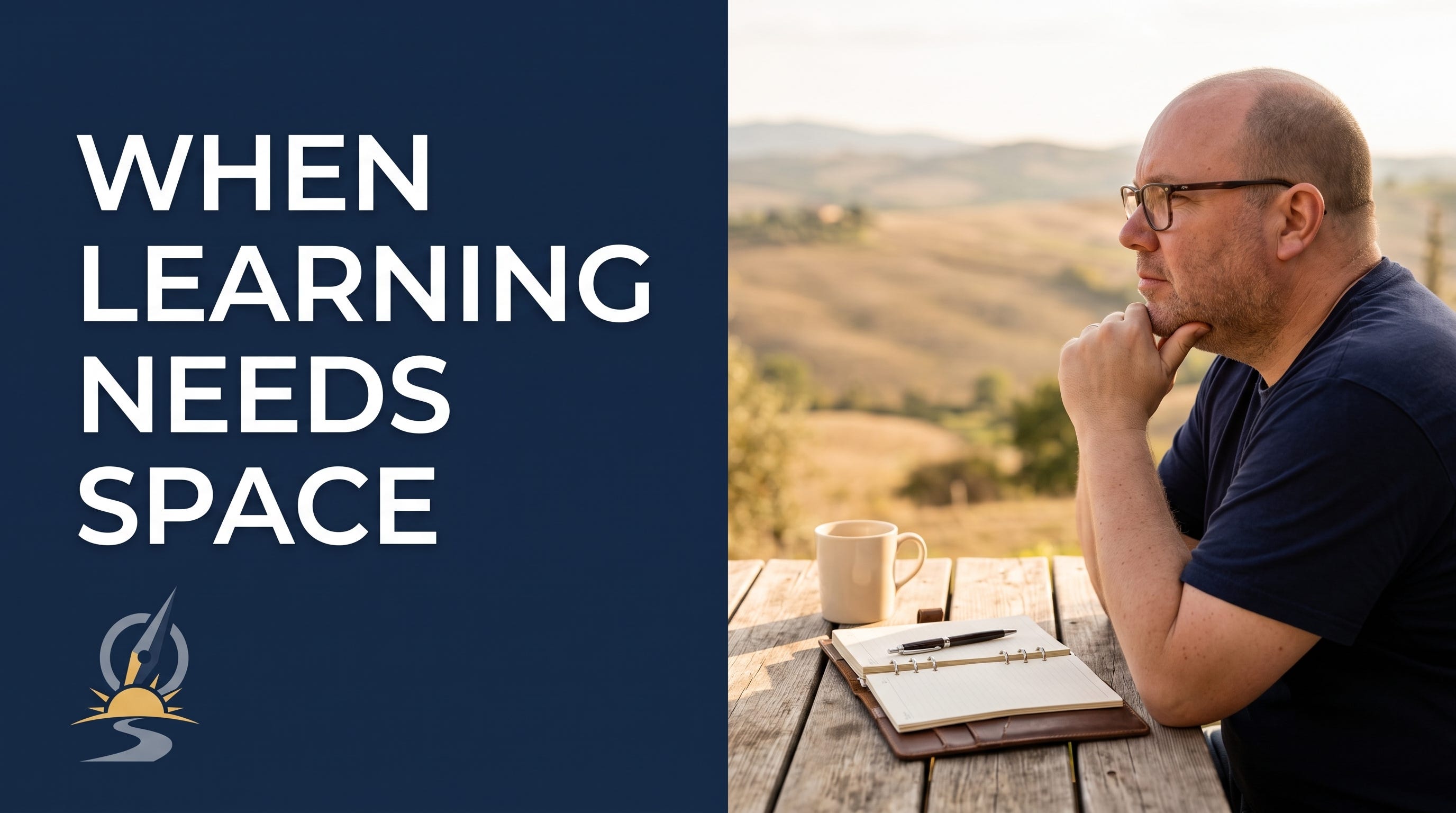
I’ve been at William Booth College for three weeks.
And now I’m on holiday.
Like me, you might feel the timing feels slightly odd.
Three weeks is long enough to begin to understand a new appointment, but nowhere near long enough to understand it properly. Long enough to learn where some of the meetings fit. Long enough to discover some of the acronyms everyone else seems to know already. Long enough to start seeing how different parts of the College connect with each other.
But not long enough for any of it to feel normal.
For most of those three weeks, I have been trying to take things in.
People. Roles. Responsibilities. Programmes. Meetings. Documents. Expectations. History. Relationships. Things already underway. Things that need attention. Things I probably haven’t even noticed yet. All that I don’t know I need to know yet!
Then I went on holiday.
Not because I had worked it all out. Quite the opposite. I needed the time to recuperate from moving house, unpacking, and starting to get my head around the new role.
And somewhere in the change of pace, I have begun to wonder whether stopping might be part of working it out.
Taking things in isn’t the same as learning
When you start a new role, there is a great deal of information.
Some of it is obvious. You need to know what you are responsible for. You need to understand the structures. You need to know who does what, what is happening when, and which things need your attention first.
So you listen. You read. You ask questions. You make notes.
I have done a lot of all four in the first few weeks.
But I am beginning to realise that taking in information and learning are not quite the same thing.
Information can arrive very quickly.
Understanding seems to take longer.
I can read a document in half an hour. It may take several weeks before I begin to see why it matters.
Someone can explain a process to me clearly. It may be some time before I understand what that process feels like for the people involved in it.
I can look at an organisational chart and see where everyone sits. That tells me very little about the history, trust, experience and relationships that actually make the organisation work.
None of that can be hurried very much.
The strange value of stepping away
The first few days of this holiday made me notice something.
My mind was still working on William Booth College.
Not in the slightly unhealthy sense of checking emails as I walked along the beach. I am trying not to do that.
It is more that things I heard during those first three weeks are beginning to settle into place.
Conversations come back to me.
Something somebody said in a meeting suddenly makes more sense.
I find myself making connections between two things that seemed unrelated at the time.
Questions are beginning to form that I didn’t know enough to ask three weeks ago.
None of this is particularly dramatic.
But I suspect some of the most important learning happens like this.
We experience something first.
We understand it later.
The trouble is that leadership and a busy appointment can leave very little room for the later.
The pressure to keep moving
Most ministry roles are very good at producing the next thing.
There is always another meeting, another email, another pastoral situation, another piece of planning, another Sunday, another deadline.
College life, I am discovering, can do much the same.
You move from one conversation to the next. You deal with what is in front of you. You make the best decision you can with what you know at the time.
And then you move on.
That is sometimes necessary.
But I wonder what happens when we never come back to what just happened.
When do we ask what we learned from the difficult meeting?
When do we think about why that conversation bothered us?
When do we notice that the thing we were certain about six months ago now looks rather different?
When do we ask whether an experience has actually changed us?
Perhaps this is part of formation too.
Not simply having experiences, but making enough room for those experiences to do something to us.
Experience doesn’t automatically make us wiser
I have fourteen years of officership behind me now. And about the same experience as a solicitor before that.
That sounds like a fair amount of experience.
But experience on its own is a slightly unreliable teacher.
You can do the same thing for fourteen years and simply become very practised at doing it the same way.
You can come away from a difficult situation convinced that everybody else was the problem.
You can repeat a successful approach long after the circumstances that made it successful have disappeared.
You can become experienced without becoming much wiser.
Reflection seems to be one of the things that turns experience into learning.
What happened?
What did I notice?
What did I miss?
Why did I respond like that?
What was going on for the other person?
What might I do differently next time?
And perhaps the harder question: what is this showing me about myself?
Those questions need some room.
Formation needs gaps
I have sometimes tended to think of formation as something active.
Reading. Training. Prayer. Conversation. Practice. Feedback. Ministry.
All of those matter.
But perhaps there also need to be gaps between them.
Space for things to settle.
Space to notice what has changed.
Space to discover that something we thought we understood has become a question again.
That feels particularly important to me now because my new role is concerned with the formation of other people.
It would be easy, I suspect, to become so busy thinking about how other people learn and grow that I stop paying attention to my own learning and growth.
Three weeks into the job, I certainly don’t have many answers about officer formation.
I have far more questions than I did when I arrived.
I’m beginning to think that might be progress.
What will I notice when I go back?
In a little while I will return to William Booth College.
Cadets will have arrived in my absence, and will busy unpacking their own homes and getting ready for their training to start. The meetings will begin again. The emails will arrive. There will be decisions to make and things that need doing.
I will probably forget some of these holiday thoughts remarkably quickly.
But I hope I don’t forget this one.
Stopping has not interrupted the learning.
It has been part of it.
And that makes me wonder how much space we give people to make sense of what they are learning.
Cadets.
Officers.
Leaders.
Ourselves.
If formation is more than passing on information, then perhaps we need to take seriously the quiet space between the experiences.
Because sometimes you don’t know what the last three weeks have taught you until the fourth week, when you finally stop.